
The skill of balancing is central to any circus. Performers may balance their own body, like on a tight rope or handstand, or they may balance objects on some part of their body.
I particularly like the face balance. It leaves my hands free to do something else, and I think it creates a really nice visual too. My favorite part—it’s easy to do just about any place, any time. This skill works well in a variety of stage routines, or as a quick party trick, since you can balance all kinds of fun and interesting objects once you’ve got the basics down.
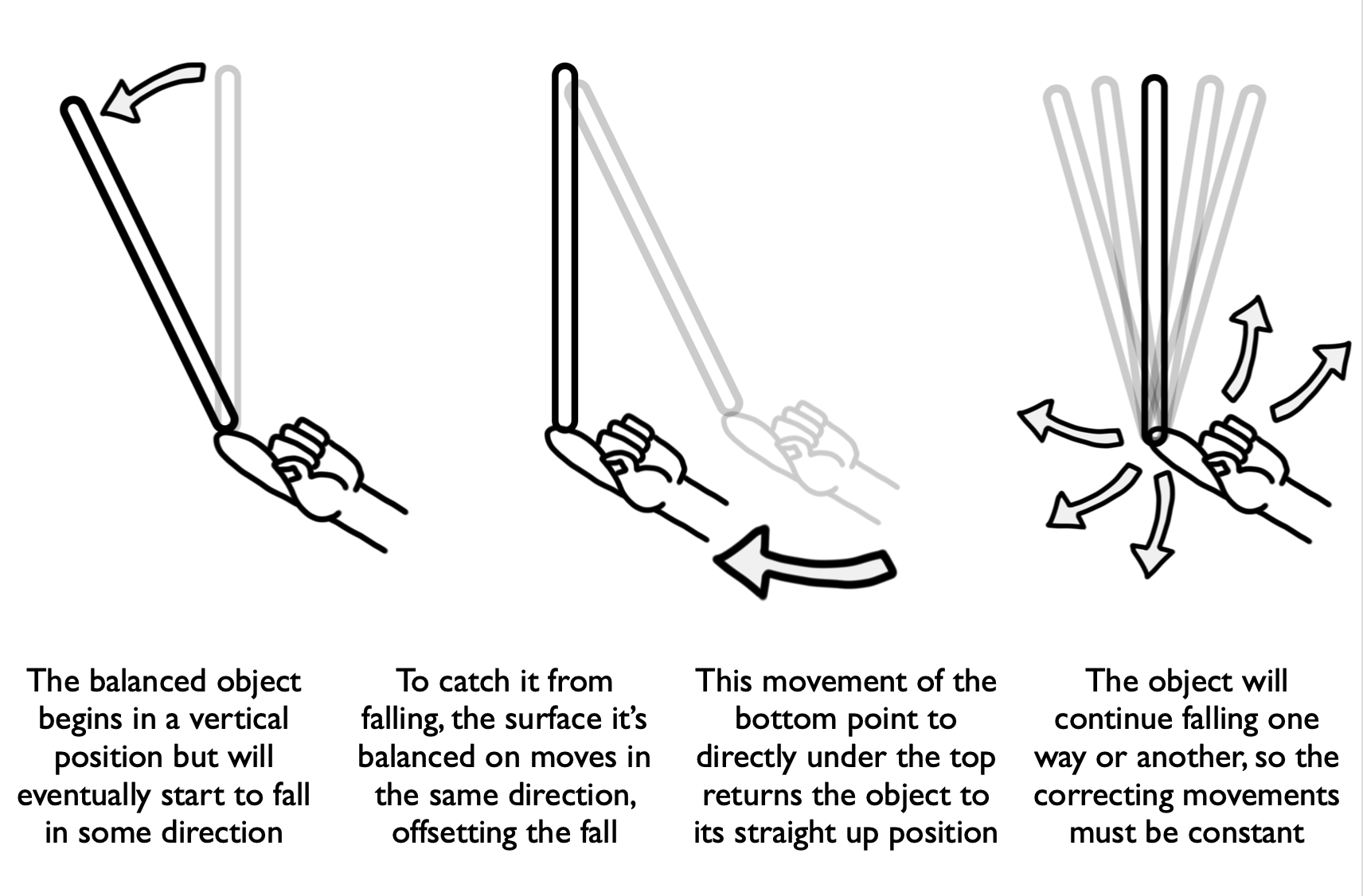
To keep an object in balance, the basic process looks like this:
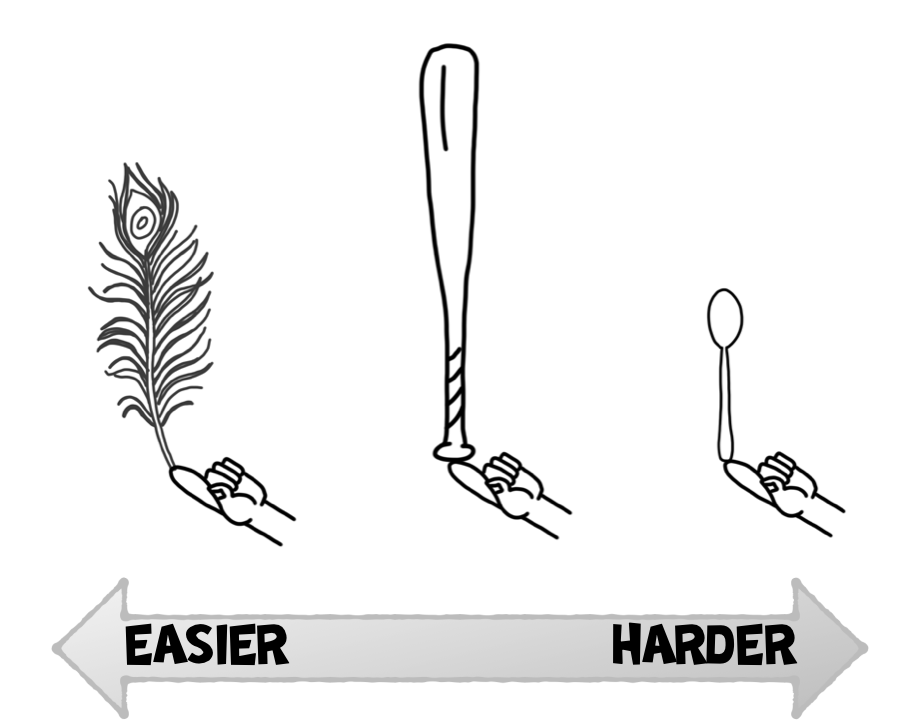
Balancing something big tends to look more impressive, but the truth is that taller objects are easier to balance than short ones. The extra height gives you more time to react and move the bottom to correct. If a broomstick, for example, starts to fall a couple of inches, a slight movement of the bottom is all it takes to correct it. But if an upright spoon on the tip of your finger fell a couple of inches, it has already practically fallen over and can't be saved. So start with something tall, work down to the spoon. If you’ve got an object that falls really slowly, like a peacock feather, that will give you a lot of extra time to correct—this is an easy way to get the hang of the movements early on.
When you’re ready to start, lock your eyes onto a spot as close to the top as possible. While you’re balancing, you can’t take your eyes off that spot. After some practice, your brain will instinctively figure out where your finger needs to move to correct; eventually, they’ll be micro movements that feel almost automatic. But your brain can only do that math if it has a constant read of how the object is moving. The second you stop watching those movements, it’ll topple right over.
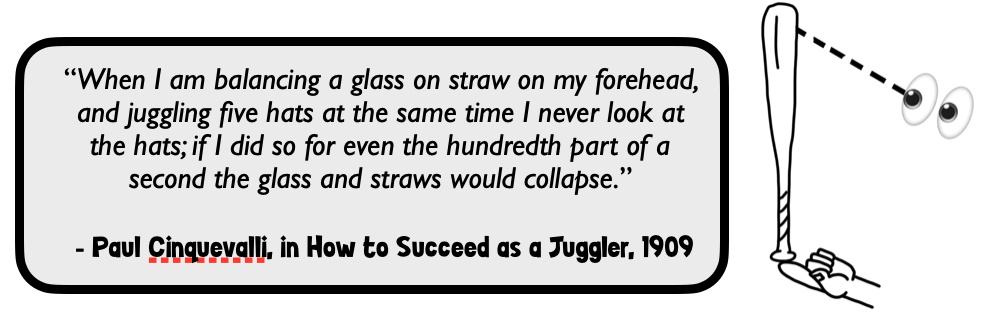
The mechanics are the same to balance something on your face. Just find a comfortable spot on your chin, nose, or forehead, and look up at the top of the object. I like the tip of the nose, but the chin can support more weight. Your forehead has good, stable surface area, plus it keeps your face unobscured (great for performers), but the forehead balance may take some extra practice, since it’s above your eyes and the movements are flipped.
The face balance conveniently frees up your hands, so you could combine it with juggling, ukulele-playing, or some other trick. Just make sure you can do the other thing completely blind, ideally without thinking about it too much, since you can’t look away from your balanced object.
Be easy on your neck here, especially if you’re practicing for long periods of time. To take some pressure off your neck muscles, keep your eyes looking upward as much as possible, and let your shoulders and upper back do some of the backward leaning, instead of relying solely on throwing your head back.
Once you feel comfortable balancing something tall, see if you can start working toward shorter objects. In his book, Juggling: What It Is and How to Do It*, circus expert Thom Wall shares a really good exercise that juggling coaches have used for a long time: start with a 3-foot wooden dowel, balance it in your place of choice, and set a timer for two minutes. If you can keep it balanced, without moving your feet, until the end of the timer, saw 2 inches off one end, then repeat the exercise. Keep going until the dowel is less than a foot long, and you’ll be a master face balancer.
(*If you have any interest in juggling, I really recommend this book. It’s thorough, easy to read, and has been a really helpful resource for me.)
Once you’ve got it down, you can experiment with balancing new objects on different parts of your body—how long can you keep an umbrella upright on the tip of your big toe?!
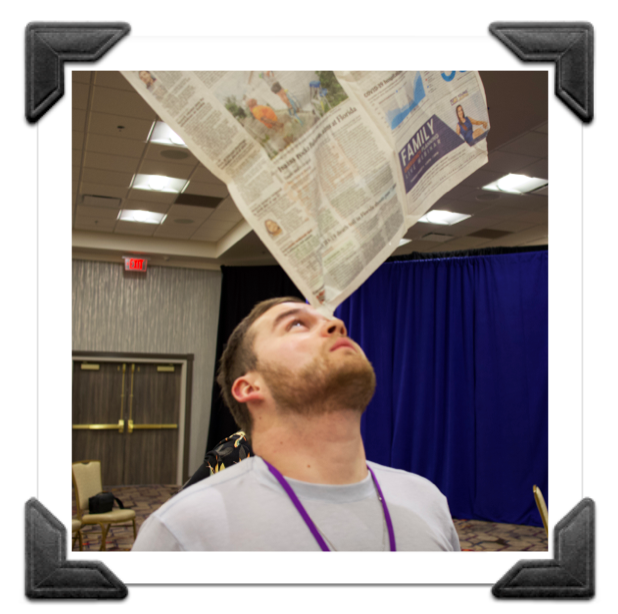
At a lecture in Las Vegas, I learned how to balance a single sheet of newspaper on the tip of my nose from the legendary juggler and magician, Charlie Frye. Here’s the trick: with a three-finger pinch at each corner, give the sheet a W-shaped crease along its diagonal, then give a slight fold or crumple to the bottom corner. The crease helps it stay upright, and the fold gives the sheet a little base that can sit on your nose.
I’ve also seen people balance lawn mowers, chairs, and even more impressive—a teaspoon. The sky (or ceiling) is the limit!
Play around and be curious. You may find something to balance that no one else has ever tried before.